
UNITED STATES SHIP INGERSOLL (DD-652)


 U.S.S.
INGERSOLL (DD-652) was named for two naval men.
U.S.S.
INGERSOLL (DD-652) was named for two naval men.
Royal Rodney Ingersoll was born in Niles, Michigan, 4 December 1847, and graduated from the Naval Academy In 1868. He served in various ships of the fleet on the European and Asiatic Squadrons until 1876 when he was assigned to the Naval Academy. Ingersoll taught and wrote about Ordnance subjects during several tours at the Academy and in the early years of the 20th century commanded such ships as the Bennington, New Orleans, and Maryland. He was Chief of Staff of the Atlantic Fleet during the first part of its famous cruise around the world, and a member of the General Board in 1908. Rear Admiral Ingersoll retired in 1909, but was called back to duty during World War I as President of the Naval Ordnance Board. In 1919 he returned to his home in Laporte, Indiana, where he was active in public affairs until his death 21 April 1931.
Royal Rodney Ingersoll, II, the grandson of Admiral Ingersoll, was born at Manila, P.I., 17 December 1913. After graduating from the Naval Academy in 1934, he served in California, Cassin, and other ships during the thirties, and reported on board carrier Hornet during her fitting out period in 1941. Lieutenant Ingersoll served in Hornet during the critical early months of the Pacific war. In the great battle of Midway 4 to 6 June 1942, in which the U.S. fleet decisively turned back the Japanese threat to the Hawaiian Islands, he was killed at his battle station.
1943 - 1946
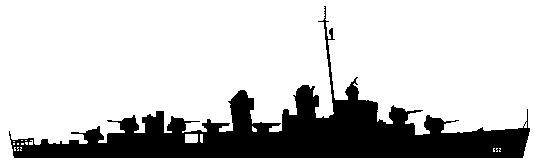
The U.S.S. Ingersoll (hull number DD-652) was launched by Bath Iron Works Corp., Bath Maine, 28 June 1943; cosponsored by Miss Alice Jean Ingersoll, granddaughter of Admiral Ingersoll, and Mrs. R. R. Ingersoll, II, widow of Lieutenant Ingersoll; and commissioned at Boston Navy Yard 31 August 1943, Commander Alexander Craig Veasy in command. The Fletcher Class destroyer's specifications were: Displacement - 2050 tons; Length - 376-feet, 6-inches; Beam - 39-feet, 7-inches; Draft - 17-feet, 9-inches; Speed - 37 knots; Complement - 317; Armament - five 5-inch, 38-cal. mounts / five twin 40mm mounts / seven 20mm mounts / two torpedo mounts with five 21-inch tubes each / six depth charge posts / two depth charge tracks.
Ingersoll conducted shakedown training off Bermuda during September and October 1943, and returned to Boston to embark Admiral Royal E. Ingersoll, Commander in Chief of the Atlantic Fleet, who was the son of the first namesake and father of the second, for a fleet review, 10 November 1943. The ship sailed 29 November to join the Pacific Fleet; and, after stops at the Panama Canal and San Diego, arrived Pearl Harbor 21 December 1943. There she joined Task Force 58 for the invasion of the Marshall Islands.
The destroyer departed 16 January with the Southern Bombardment Group, and
began pre-invasion firing on Kwajalein 30 January. The landings began the next
day with Ingersoll lying offshore in her vital support role. With the victory won, she
retired to Majuro 5 February, but was underway again 16 February to screen the fast
carrier forces in their devastating raid on Truk 17
to 18 February. After this attack, "The Gibraltar of the Pacific" was
untenable as a major base for the Japanese. After air strikes in the Marianas, Ingersoll
returned with the carriers to Majuro 26 February 1944.
With the victory won, she
retired to Majuro 5 February, but was underway again 16 February to screen the fast
carrier forces in their devastating raid on Truk 17
to 18 February. After this attack, "The Gibraltar of the Pacific" was
untenable as a major base for the Japanese. After air strikes in the Marianas, Ingersoll
returned with the carriers to Majuro 26 February 1944.
Then on 7 March 1944 the versatile destroyer sailed for Espritu
Santo, New Hebrides, but soon returned to Task Force 58 for carrier strikes
against the Palaus and Hollandia.In the months that followed, the ships hit Ponape twice with shore bombardments and screened carrier
strikes in the Palaus in connection with the advance
of American combined forces. Ingersoll and the other ships remained at
sea for long periods during these support operations, refueling and
replenishing underway when necessary.
Ingersoll took part in pre-invasion bombardments of Peleliu 7 September 1944, and early in October 1944 joined
in the sortie of Task Force 38 for one of the most important operations of the
war. The giant fleet rendezvoused 7 October 1944 west of the Marianas, and
launched air strikes on Okinawa and the Philippines. The ships then moved to
their real objective -- Japanese air strength on Formosa. In three days of
attacks Formosa's value as a base was severely reduced, while air strikes on
the American fleet were repulsed by Combat Air Patrol and the gunfire of Ingersoll
and her sister ships.The
carrier groups turned southward from Formosa to launch strikes against targets
in the Philippines.
In late October 1944 the Japanese moved in a three-pronged attack to repel the invasion of the Philippines and force a decisive naval battle. The ensuing battle was the four-part Battle for Leyte Gulf, in which Ingersoll and her task group played an important role.
Her carrier planes struck Admiral Kurita's fleet a devastating blow in the
Sibuyan Sea 24 October 1944.That evening Admiral Halsey turned Task Force 38 northward in
search of Admiral Ozawa's carrier group. Carrier strikes the next
morning dealt crippling blows to the Japanese in the Battle off Cape Engano.When
Admiral Halsey detached part of his fleet southward to intercept Kurita, who
had slipped through San Bernadino Strait, Ingersoll
joined Admiral Dubose's group in pursuit of the fleeing remnants of the
Japanese fleet. During the long stern chase Ingersoll fired one torpedo
at long range, but the group did not engage the remaining Japanese heavy ships.
After the great victory Ingersoll returned to Ulithi
for a well-earned rest and overhaul. She got underway again in January 1945
with fast carrier forces for strikes on Formosa, the Philippines, and the coast
of China. From 3 to 9 January these operations supported the Lingayen landings
directly.Then
Halsey took his ships on a daring foray into the South China Sea, striking Indo
China, Hainan, and the China coast in a graphic demonstration of the power and
mobility of American carrier groups when supported by destroyers and heavy
units.This pivotal operation was
completed 20 January 1945; Ingersoll was detached 1 February 1945 to
sail to Pearl Harbor. She arrived 7 February 1945, and after training exercises
steamed to San Pedro 15 February 1945.
Following battle repairs and crew rotation Ingersoll got underway for
Pearl Harbor 18 April 1945 and after training exercises sailed for Ulithi 2 May 1945. From that staging base she steamed
toward Okinawa serving as a patrol vessel and screening flight operations.
While off Okinawa 24 May 1945 the ship engaged a small suicide boat, and the
next day she shot down two Japanese aircraft during one of the many air raids.
Two more planes were splashed 28 May, and Ingersoll continued the hectic
patrol and picket duty through June.
With Okinawa won, the ship rejoined Task Force 38 on 1 July 1945. Again acting
as a screening and support ship, she took part in the final devastating raids
on Japan and other Japanese-held Islands. She also bombarded the Iron works at Kamaishi 15 July as part of a battleship, cruiser, and
destroyer group in one of the first operations against the home Islands by
surface ships.
After the surrender of Japan 15 August, Ingersoll assisted with the occupation; she was anchored in Tokyo Bay for the surrender ceremonies on board Missouri 2 September 1945. The veteran destroyer remained in Japan to help demilitarize Japanese bases, departing 5 December 1945 for the United States. After a long voyage via San Diego and the Canal Zone, she arrived Boston 17 January 1946. Ingersoll arrived Charleston, South Carolina, 4 April 1946; decommissioned 19 July; and joined the Atlantic Reserve Fleet.
The Ingersoll and eligible personnel earned the American Campaign Medal, the Asiatic-Pacific Campaign Medal (with nine bttle stars), the World War II Victory Medal, the Navy Occupation Medal (with Japan bar), the Philippine Presidential Unit Citation, and the Philippine Liberation Medal (with two battle stars) for World War II service and service following the war until she was decommissioned.
1951 - 1970

The U.S.S. Ingersoll (hull number DD-652) was recommissioned at Charleston 4 May 1951, Lieutenant Commander George A. Gowen in command, in response to the UN Forces' growing need for naval support during the Korean conflict. The destroyer received extensive modification in the following months. The number three 5-inch 38-cal. mount was removed and replaced with a twin 3-inch 50-cal. mount and a Mark 34 fire control director. The forward torpedo mount was removed and replaced with twin 3-inch, 50-cal. mounts and Mark 35 fire control director systems on each side. All of the 40mm and 20mm gun mounts were removed. The single mast and surface search radar antenna were removed and replaced with a tripod mast and SG-1 surface search antenna (the original SC "bed spring" air search antenna was remounted and was eventually replaced with an SPS-6 antenna and system during a 1953 yard period). The forward 40mm mounts were replaced with Mark 10 "hedgehog" mounts. The original sonar system was replaced with an SQS-39 sonar system and the main battery director fire control radar system was replaced with a Mark 25 radar system.
Following sea trials during March 1952 the veteran fighting ship operated from her home port at Newport along the Atlantic Coast and in the Caribbean. On 26 August 1952 the destroyer departed for Scotland and the North Sea where she participated in the first NATO large-scale amphibious training exercise "Operation Mainbrace" and then joined the 6th Fleet in the Mediterranean. She operated in that critical region, helping to prevent a spread of the conflict to Europe until returning to Newport 10 February 1953.
Training operations occupied Ingersoll until she departed Newport for the Far East 10 August 1953. Sailing via the Panama Canal, San Diego, Pearl Harbor, and Midway Island, she arrived Yokosuka, Japan, 14 September to begin operations with Task Force 77 off Korea. Ingersoll and Cogswell (DD-651) were detached from Task Force 77 to operate with the British aircraft carrier HMS Ocean from 3 to 15 October to assist in the helicopter transfer of Indian troops from her flight deck to Panmunjam to act as neutral truce keepers. Upon returning to Task Force 77 the ships sailed off Korea in support of the armistice, before moving to the Formosa area to help stabilize the volatile strait in November-December. Ingersoll then sailed to Hong Kong, Singapore, Colombo, Ceylon (Sri Lanka), Bahrein (GB), and Port Aden (GB), and then steamed westward to transit the Suez Canal 13 February 1954. After stopping at Genoa, Barcelona, Lisbon, and Bermuda, she completed her circuit of the globe upon arrival Fall River, Massachusetts, 18 March 1954.
Following repairs and training, the veteran ship departed Newport 30 November 1954 to permanently join the Pacific Fleet arriving 15 December at her new home port San Diego. She departed San Diego 4 January 1955 and rejoined the 7th Fleet in time to take part in the, evacuation of the Tachen Islands, which threatened to bring war between Chinese Nationalists and Communists. After fleet maneuvers the ship spent March and April at Formosa helping to train Nationalist sailors. Ingersoll returned to San Diego 19 June 1955 ending another highly successful cruise in the Far East.
The destroyer returned to 7th Fleet duty January to April 1956; and, after her return to San Diego 26 April, engaged in training operations until August. From 27 August to 8 December Ingersoll underwent a yard period in San Francisco in which a new underwater fire control system was installed. After additional evaluation and antisubmarine training the ship sailed again 16 April 1957 for the western Pacific. On this cruise Ingersoll stopped at Melbourne, Australia, and the Fiji Islands, participating in fleet exercises off Guam and the Philippines. in August the destroyer steamed to Taiwan for the now familiar Formosa Patrol, helping to maintain peace and stability in those troubled waters. After carrier exercises she sailed for home, arriving San Diego 14 October 1957.
Ingersoll returned to the Far Fast with the 7th Fleet 25 June to 18 December 1958; and, in the early part of 1959, took part in type training and readiness operations off California. The veteran ship sailed westward once more 15 August 1959 and operated with a submarine hunter-killer group during most of her deployment. She returned 1 February 1960, as trouble began to mount in Southeast Asia.
The destroyer got underway with a hunter-killer group for the Far East 1 October 1960, and after spending October and November training in Hawaiian waters steamed to the South China Sea to support American efforts to stabilize the threatened kingdom of Laos. In December she screened transports during the landing of a battalion landing team destined for Laos to enforce the Geneva solution. She remained off South Vietnam until April; returning to her homeport 2 May 1961.
Ingersoll spent the remainder
of 1961 on the West Coast, then sailed 6 January 1962 for duty with the 7th
Fleet that Included cruising with carrier Hancock (CVA-19) off South
Vietnam when trouble flared again in Laos. She also patrolled Taiwan Straits in
response to the reports of Communist troops on the mainland opposite the
Nationalist Island. She returned to San Diego 18 July 1962 for western seaboard
operations until October 1962 when the Cuban missile crisis broke. Ingersoll
responded quickly, sailing with an amphibious group to the Canal Zone in case
additional troops were needed in the emergency. When the sea blockade coupled
with strenuous American diplomacy resulted in the removal of the missile
threat, she resumed training out of San Diego. She returned to the Far East in
October 1963 to support carrier operations in the East and South China Seas and
resumed operations out of San Diego in the spring of 1964.
Ingersoll completed a yard overhaul 5 February 1965, conducted readiness operations for a WestPac deployment along the seaboard, and then sailed from San Diego 9 June 1965. Upon arriving in Subic Bay, PI, she sailed the next day to join the “Market Time Patrol” on 5 July to begin coastal surveillance patrols to intercept and stop smuggling of Viet Cong (VC) and supplies. On 20 July, she became Gun Ship Da Nang, providing Naval Gunfire support to the Vietnamese Army. Anchoring daily in the outer harbor of Da Nang, she operated in “Brown Waters” of South Vietnam designated by the Veterans Administration for Agent Orange. She conducted 5 gunfire support missions against 18 enemy targets. She next joined the Naval Gunfire Support Group off the coast of Quang Ngai. Her guns delivered powerful aid to friendly troops throughout the summer and well into the fall in III of IV Corp Areas. Following a 30-day assignment as Station Ship Hong Kong, she took time out for plane guard and screen duties with fast carriers, including Independence (CVA-62) and Midway (CVB-41), as they launched hard hitting air strikes on inland and coastal target in North Vietnam.
Heading to Sasebo, Japan for the return home, she was sent back to Vietnam for 3 gunfire support missions in the Gulf of Siam in the IV Corp Area. The final three (3) gunfire missions fired by Ingersoll were 7 miles up the Saigon River in the “Brown Water” Area of South Vietnam. The target of the last mission was a VC Ammunition Depot under joint attack by B-52 Bombers from Guam and the cruiser Galveston (CLG-3). After being spotted on to the target, Ingersoll was requested to provide continuous 4 gun salvos until all magazines were emptied.
The Department of Veterans Affairs published an Addendum Compensation & Pension Service Bulletin, Volume 1, Issue 7 on July 31, 2007. The Bulletin authorized “Herbicide Exposure Presumption Extended to USS Ingersoll Crewmembers”, as set forth below.
“The USS Ingersoll (DD 652) operated as a Navy destroyer gunship providing fire support for military ground operations along the Vietnam coast during 1965. In addition to coastal duty, the USS Ingersoll traveled up the Saigon River on October 24th and 25th of 1965 to fire on enemy bases. C&P Service has reviewed the ship’s deck logs, located at the National Archives and records Administration, and confirmed this service in the “inland waterways” of Vietnam. As a result, the presumption of herbicide exposure, as described in 38 CFR 3.307(a)(6)(i), should be extended to any crewmember who served aboard ship during October of 1965. This presumption is authorized by M21-1MR section IV, ii.2.C.10b. Regional offices should reevaluate any disability claim based on herbicide exposure from one of these veterans that has been denied.”
The experience gained from Ingersoll’s performance as Gun Ship Da Nang set the foundation for the Naval Gunfire Support Group. Ingersoll is believed to be the only destroyer to perform combat missions in the “Brown Waters” of South Vietnam (Da Nang Harbor and Saigon River).
A total of twenty-four (24) combat missions were fired against 116 enemy targets during this deployment. This resulted in firing of over 60,000 rounds of 5” 38 ammunition. All four (4) gun barrels were replaced in early 1966, due to excessive wear and erosion of gun barrel rifling.
On 4 November she headed home and
arriving San Diego 23 November for a much deserved leave and upkeep period
extending through 31 December.
In early
1966, all 5” 38 gun barrels of Ingersoll
required replacement from erosion of the rifling, followed by training operations
along the West Coast and Hawaii. She
departed San Diego on 5 November 1966 for the Far East and upon arriving in the
Tonkin Gulf was assigned to “Operation Sea Dragon”. Ingersoll
provided anti-shipping, interdiction operations in the coastal waters of North
Vietnam and plane guard duty for Kitty Hawk (CVA-63). She was also the rescue ship for downed
pilots shot down over North Vietnam. On
6 December, while at Condition II, Ingersoll
locked on to a North Vietnamese coastal battery that fired at the
destroyer. The ship’s prompt
counter-battery fire destroyed the coastal battery, whose artillery shells hit
the bridge of Ingersoll with no
damage. Her assignment was completed
with the recovery of 7 downed pilots in North Vietnamese waters. She continued to operate in Oriental waters
until returning home the spring of 1967 to prepare for future assignments. Ingersoll spent the next year undergoing
refitting and repairs in the Long Beach shipyard with Refresher Training
following.
With the Vietnam conflict continuing to escalate, by June 1968, Ingersoll
was ready to set sail for the WestPac once again. This would be her final
deployment. Ingersoll arrived in the combat zone off the coast of
Vietnam in July where she participated in various operations, from plane guard
at "Yankee Station", naval gun support for Army and Marines, and
attacks against North Vietnamese craft as part of "Sea Dragon".
"Sea Dragon" would be significant for Ingersoll. She was under
the command of Commander John M. Redfield steaming as part of Task Group 77.1.1
composed of Canberra (CA-70) off the coast of North Vietnam. Her task
was to interdict North Vietnamese traffic moving material southward along the
coast. From 29 to 31 October, Ingersoll expended 332 rounds of 5-inch
38-cal. AAC, SPDF, VT Frag, and star shells while
sinking numerous water-borne-logistics-craft (WBLCs). On 1 November, Ingersoll
began conducting naval bombardment of Han Matt Island, North Vietnam. She
ceased fire at 12:32 and secured from general quarters. These actions during
the waning months of 1968 would mark the last time Ingersoll's guns were
ever fired during hostile activity.Shortly thereafter, she began her transit back to San
Diego, ending her last overseas deployment. Fifteen months later, in January
1970 at San Diego Naval Station, Ingersoll's colors were struck for the
last time ending over a quarter century of service to the Fleet and to the
Nation.
For service during the Korean and Vietnam eras, the Ingersoll and eligible personnel earned the Europe bar for the previously awarded Navy Occupation Medal, the China Service Medal, the National Defense Medal (with one bronze star - two awards, Korea and Vietnam), the Korean Service Medal, the Vietnam Service Medal (original award with three battle stars), the Republic of Korea Presidential Unit Citation, the RVN Gallantry Cross, the United Nations Service Medal (Korea), and the RVN Campaign Medal.
EPILOG
The U.S.S. Ingersoll (DD-652) was sunk as a target. The towboat dispatcher Ed Jeklik (ETCS, USN - Ret.) recorded this final entry in the U.S.S. Ingersoll (DD-652) log: "Ingersoll went down at 0618 on 19 May 1974 at (118o 34' 7'' W, 33o 34' 8" N)* in 350 fathoms of water". Jeklik stated that "Our tow-boat Pacific Ranger had towed her to that location and she was sunk by naval gunfire. At least she was not cut up for scrap as many of our ships have been. She did not die easily and the Pacific Ranger had to standby to make sure she sank". However, the Ingersoll name continued for another eighteen years with the Spruance Class Destroyer U.S.S. INGERSOLL (DD-990) named for Admiral Royal E. Ingersoll the son of Admiral R. R. Ingersoll and the father of Lieutenant R. R. Ingersoll, II. She was commissioned 12 April 1980, decommissioned 24 July 1998, and sunk as a target 3 July 2003.
PLEASE NOTE: This is an edited version of the U.S. Navy's official Archive history of the USS Ingersoll (DD-652) and was updated August 14, 2011 * These coordinates may be incorrect. If there are any other errors or if additional information should be added, please let me know. My E-mail address is: lgraham5@nycap.rr.com
"The Rifle Regiment March" by John Philip Sousa
**
DISCLAIMER: The background music (a MP3 file) on this page is copyrighted.
I make no claim to the copyright or ownership.
If you are aware of a copyright infringement, email me
and I will remove the offending file.